Understanding electrochemical migration: causes & solutions
Electrochemical migration, or ECM, is a failure mechanism where metal ions migrate under an electric field and form conductive dendrites. It causes shorts and intermittent faults in PCBs and power electronics, especially in humid conditions. Industry data shows ECM remains a leading root cause in field failures. This article explains causes, stages, risks, and practical solutions manufacturers can implement now today.
Key takeaways
-
ECM forms when ions migrate under voltage and moisture, producing dendritic shorts.
-
Contamination control, humidity management, conformal coatings, and design choices reduce risk.
-
Testing and in-line monitoring identify vulnerable assemblies early.
ZESTRON offers cleaning chemistries, process validation, and analytical support to help OEMs improve yield and reliability in electronics manufacturing with measurable results and global technical centers and training.

What is electrochemical migration?
Electrochemical migration is an electrochemical process where solvated metal ions move from an anode to a cathode over a substrate, often driven by DC bias. Dendritic filaments grow, bridging conductors and causing leakage or shorts. ECM differs from corrosion in that it requires an electrical field and ionic mobility. Understanding the mechanism helps manufacturers target controls in process and design today.
Definition and overview
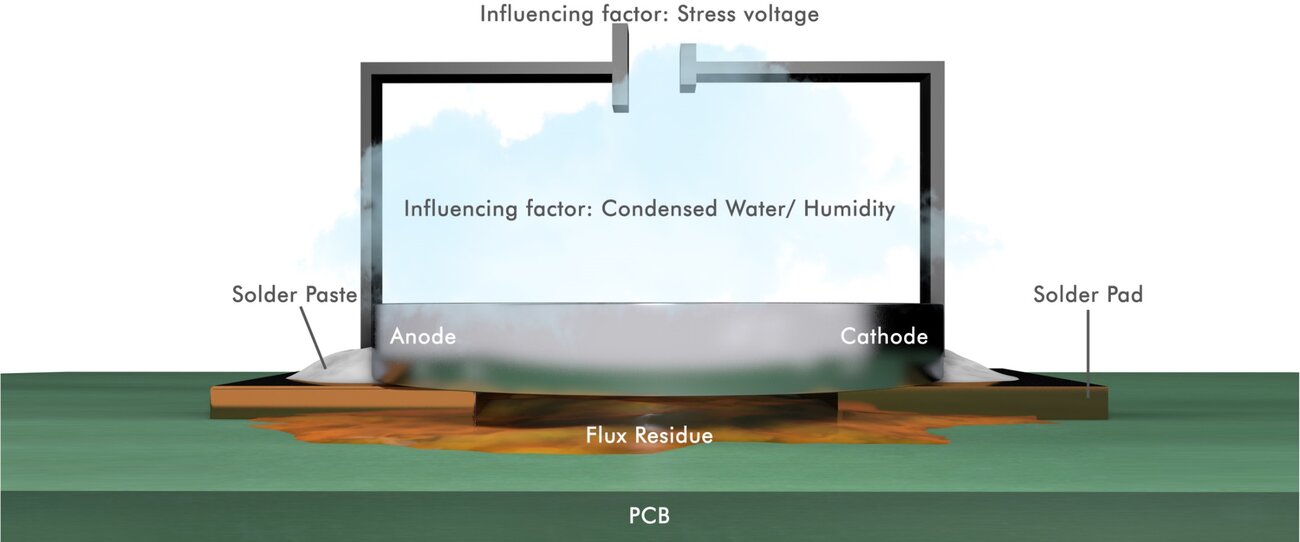
At the molecular level ECM involves metal dissolution at anodic sites, ionic migration through thin electrolyte films, and reduction at cathodic sites forming metallic bridges. Typical contributors are halide ions, flux residues, salts from handling, and acidic residues. Growth rates depend on current density and ion concentration. Dendrites can form in hours under adverse conditions, making early prevention critical in production.
Importance in electronics industry
ECM threatens reliability across consumer, industrial, automotive, and aerospace electronics. Field failures cause warranty costs, recalls, and safety risks in high-reliability applications. Studies show assemblies exposed to damp environments experience ECM-related failures at rates up to 1 percent in uncontrolled processes. Managing ECM preserves credibility, reduces replacement costs, and increases mean time between failures. Companies prioritize cleaning, testing, and conformal coating.
Causes of electrochemical migration
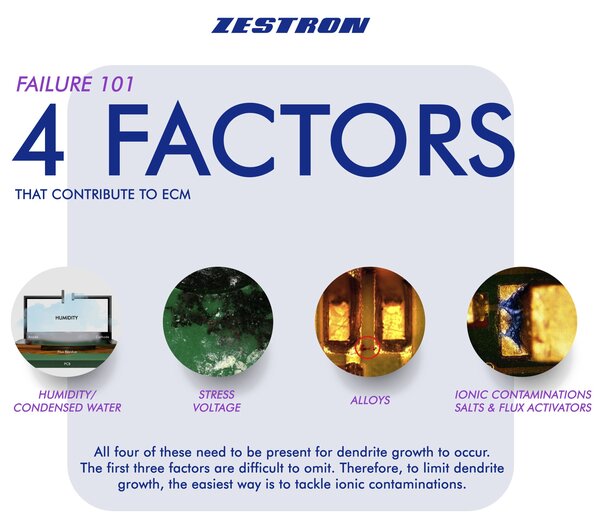
ECM arises from a combination of an electric field, conductive contaminants, and moisture. Each factor amplifies the others, so small residues become high-risk under bias. Sources include improper cleaning after soldering, human handling, contaminated incoming parts, and flux residues from no-clean processes. Understanding root causes enables targeted corrective actions such as cleaning chemistry selection, and material controls to reduce ion availability.
Electric field and ionic contaminants
An electric field provides the driving force for metal ion transport. Even millivolt bias across small gaps can attract ions dissolved in thin surface films. Contaminants supply ions; chloride, bromide, sulfates, and ammonium salts are common. Ionic strength determines conductivity of the film and dendrite growth rate. Minimizing residue concentration and potential differences between adjacent conductors reduces ECM likelihood significantly rapidly.
The role of moisture in ECM
Moisture creates the electrolyte layer that enables ion mobility. Relative humidity above 60 percent vastly increases thin-film conductivity on boards with residues. Condensation, splash, or high ambient humidity all raise risk. Water content affects ion solvation and dendrite nucleation rates. Controlling humidity in assembly, storage, and transport is a practical line of defense, combined with cleanliness and coatings for redundancy effectively.
Impact of environmental factors
Temperature cycling, airborne contaminants, and process chemicals influence ECM risk. Higher temperatures accelerate ion mobility, while thermal cycling can crack conformal coatings and expose fresh surfaces. Outdoor or unfiltered factory air increases deposition of salts and sulfates. Transportation conditions such as sea freight and humid storage are high risk for assemblies that are not sealed. Environmental control complements cleanliness for reliability.
The process of electrochemical migration
ECM progresses through metal dissolution, ion transport, and metal deposition. Local anodic dissolution releases ions that migrate across moisture films toward cathodic sites where reduction occurs. Filament initiation depends on nucleation sites, often driven by contamination patterns or surface roughness. Once a dendrite bridges conductors, current concentrates and growth accelerates. Time to failure varies from minutes to months, depending on conditions.
Stages of dendritic growth
Dendritic growth follows predictable stages: initiation, growth, and shorting. Initiation requires a local ion concentration and nucleation site, frequently at flux residue or a scratch. Growth is directional toward the cathode, forming branching metallic filaments. As branches thicken, resistance drops and current increases, further accelerating deposition. Final short occurs when a stable metallic bridge completes the circuit, causing failure rapidly thereafter.
 Factors accelerating ECM
Several process and design factors speed ECM: high current density, close conductor spacing, elevated humidity, and high ion concentrations. Assembly practices such as insufficient cleaning after soldering or using low-quality flux increase residue. Thermal stress and vibration can break protective films. Certain salts, especially chlorides, catalyze metal migration. Reducing one or more accelerating factors lengthens component life and lowers failure rates.
Material susceptibility
Some materials are more prone to ECM than others. Copper, silver, and tin readily dissolve under anodic conditions. Surface finishes like ENIG, immersion silver, and HASL interact differently with contaminants. Polymer residues can trap salts and retain moisture. Selection of finishes, solder alloys, and board laminates affects ion release and film formation. Specifying compatible materials reduces intrinsic susceptibility in procurement practices.
Risks and consequences
ECM leads to transient failures, permanent shorts, and degraded insulation resistance. In safety-critical systems, ECM can cause malfunction with severe consequences. Hidden leakage increases power consumption and heats components, accelerating other failure modes. Economically, ECM raises returns, repair costs, and warranty liabilities. Understanding these risks helps prioritize investments in cleaning, testing, design changes, and supply chain controls to limit exposure proactively.
Electrochemical migration and component reliability
Component reliability suffers because ECM is intermittent and environment dependent. Devices can pass bench tests yet fail in field when humidity or contamination changes. Mean time between failures declines as ion availability and bias increase. Reliability engineering requires accelerated testing to reveal ECM potential and process controls to close gaps. Suppliers and manufacturers must align specifications and cleaning validation for reliability.
Common issues due to ECM
Typical field issues include intermittent shorting, erratic behavior, contact corrosion, and connector failures. Power supplies may trip due to leakage, sensors return false readings. Intermittent faults are expensive to diagnose and reproduce. Many returns are closed as 'no fault found' when ECM conditions are not replicated. Failure analysis must consider ECM when contamination or moisture is present during warranty investigations regularly.

Preventive measures and solutions
Preventive strategies combine cleanliness, environmental control, design, and verification. Effective cleaning removes ionic residues, while humidity control prevents electrolyte formation. Design choices such as increased spacing, guard traces, and conformal coatings limit dendrite paths. Monitoring and testing validate that processes keep ion levels below critical thresholds. Implementing layered controls reduces single-point failures and supports consistent manufacturing yields and long-term field reliability.
Implementing layered controls reduces single-point failures
-
Humidity control strategies
Controlling relative humidity is straightforward and effective. Maintain assembly and storage environments below recommended thresholds, typically 40 to 50 percent relative humidity, adjusted for product sensitivity. Use dehumidified storage, sealed packaging, and dry cabinets for moisture-sensitive assemblies. In-process controls include local enclosures, desiccant chambers, and air filtration. Monitoring with calibrated sensors and alarms ensures immediate remediation when conditions drift or breaches.
-
Testing and monitoring techniques
Detecting ECM risk requires targeted testing: ionic contamination tests (e.g., ion chromatography), surface insulation resistance, and biased humidity tests such as HAST or BHT. In-line monitoring includes residue sensors and periodic cleanliness audits. Accelerated life tests simulate field humidity and bias to reveal susceptibility. Data-driven SPC tracks trends and helps trigger corrective actions when contamination or test results cross established thresholds and respond.
-
Design considerations to mitigate ECM
Design choices can reduce ECM risk without expensive process changes. Increase conductor spacing where possible, add guard traces tied to ground to intercept dendrites, and avoid narrow combinational geometries near high voltages. Specify creepage and clearance consistent with application environment. Use solder masks and conformal coatings in critical areas. Mechanical design to prevent moisture trapping, and choosing robust finishes, lowers susceptibility.
Role of ZESTRON in mitigating ECM
ZESTRON provides cleaning chemistries, validation services, and analytical testing to reduce ionic residues and contamination. ZESTRON’s labs perform ion chromatography and surface analysis to quantify risk and optimize cleaning processes. They develop process-specific protocols, help select compatible materials, and support on-site trials at global technical centers. Combining ZESTRON cleaning solutions with environmental and design controls improves yield and field reliability significantly.

Future trends in electrochemical migration management
Future ECM management emphasizes predictive analytics, inline contamination sensing, and smarter materials. Machine learning applied to production and environmental data will identify conditions that precede failures. Advanced coatings and self-healing materials show promise to arrest dendrite initiation. Improved cleaning chemistries reduce residues with lower environmental impact. Collaboration between material suppliers, OEMs, and service providers like ZESTRON accelerates ECM control adoption industrywide.
Emerging technologies and innovations
Emerging solutions include advanced surface analytics, localized humidity control, and nano-scale coatings that repel ions. Sensors that detect ionic contamination in real time are becoming practical for high-volume lines. Additive approaches, such as conductive polymer barriers or sacrificial anodes, are under evaluation. Traceability helps find contamination sources. Integrating these innovations into quality systems reduces ECM surprises in fielded products and costs.
Ongoing research and development
Academic and industrial research focuses on understanding nucleation mechanisms and identifying inhibitors that prevent dendrite formation. Studies quantify how specific ions influence growth kinetics and how surface treatments alter nucleation thresholds. R&D also evaluates greener cleaning agents and faster analytics to shorten validation cycles. Pilot programs between OEMs, universities, and companies like ZESTRON are generating practical data for next-generation process controls.

Conclusion
Electrochemical migration combines electric bias, ions, and moisture to produce dendritic shorts that impair reliability. Effective mitigation blends cleaning, humidity control, design, testing, and protective coatings. ZESTRON’s cleaning chemistries, analytical labs, and technical centers help manufacturers validate processes and reduce ion availability. Implement layered controls, monitor with data, and prioritize high-risk assemblies to lower field failures and improve product reliability.
FAQ
Frequently asked questions below cover environments, testing, cleaning, and coatings. These concise Q&A entries help practitioners prioritize actions and understand common issues. For deeper assistance, ZESTRON technical centers provide audits and lab testing worldwide. Answers summarize industry practice and link to practical steps like humidity control, ionic testing, cleaning protocol selection, and coating strategies that reduce ECM risk in production worldwide.
Environments with high humidity, temperature cycling, and airborne salt or chemical contamination are most susceptible to ECM. Coastal facilities, unfiltered assembly spaces, and storage without desiccation frequently see higher incidence. Shipments that experience condensation during transit are also at risk. Review storage, transport, and assembly environmental data and implement humidity control, sealed packaging, and contamination reduction measures for high-risk products only.
Production testing combines cleanliness assays, electrical stress testing, and accelerated humidity bias exposure. Common lab tests include ion chromatography for surface ions, surface insulation resistance at defined voltages, and biased humidity soak tests to provoke dendrite growth. In-line checks use residue sensors. Statistical process control monitors trends and triggers corrective actions when contamination or test results cross established thresholds and respond.
Cleaning reduces ionic residues and is a primary control, but it does not guarantee zero risk alone. Proper chemistry, temperature, and time are necessary to reach target cleanliness levels. Some contaminants are embedded or reintroduced during handling, so process controls and material selection complement cleaning. ZESTRON cleaning validation services help define acceptable ion limits and procedures to sustain low residue during production.
Conformal coatings provide an insulating barrier that prevents electrolyte formation on critical surfaces and physically blocks dendrite growth. Coatings differ in dielectric strength, moisture permeability, and adhesion; selection must match operating environment. Applied correctly, coatings extend time to failure and serve as redundancy when cleaning is imperfect. ZESTRON advises on coating selection, cure verification, and compatibility with cleaning chemistries and rework.