Cleaning 101
How to Clean Your PCBAs
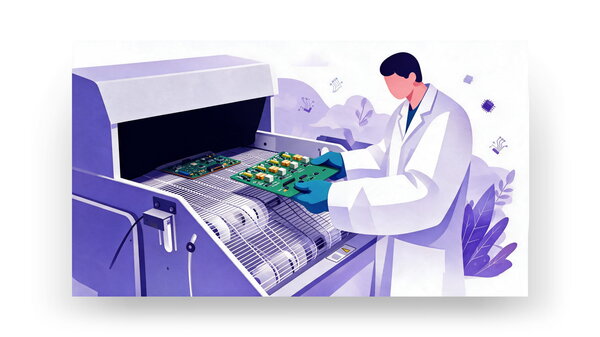
When a circuit board fails in the field, the cost goes well beyond a replacement part. In automotive, medical, aerospace, telecom, and defense products, a single failure can mean recalls, downtime, or worse. One of the most overlooked ways to prevent that is simple: get the contamination off the board before it ships.
Why boards are harder to clean than they used to be
Electronics keep doing more in less space. To get there, designers are packing boards more densely, stacking components, lowering the gap between parts and the board, and leaning on more delicate materials. Any one of these presents opportunity for trapped residue and increases the difficulty to flush out. A cleaning process that worked on last generation's assemblies may not reach the tight spaces on today's.
That is why the choice of cleaning chemistry and equipment deserves real attention. The agent must be effective in the tightest spots and compatible with the materials on the board.
What leftover residue can cause
Solder paste ingredients such as resins and rosins are essential during assembly. The trouble starts when their residues stay behind, along with contamination picked up from handling. We see three failure modes show up again and again:
1. Electrochemical migration
When a DC voltage is present and contamination provides a path, metal can begin to grow into conductive filaments or branching, tree-like dendrites. These unintended bridges can short components. They come in two forms: conductive anodic filaments, which grow inside the board, and dendrites, which grow across its surface.
2. Leakage current
Flux activators are the most common culprit here. No-clean fluxes are designed to seal their activators inside an inert resin, but real-world soldering is messy. Uneven heat, the thermal profile, heavy components, and varying copper distribution can all leave activators incompletely sealed. Add environmental moisture, and current can leak between conductors. In sensitive areas, such as near ground or voltage traces, support capacitors, oscillator pins, or measurement bridges, that can degrade signal integrity and eventually cause component or board failure.
3. Conformal coating defects
Conformal coatings, from thick silicone to ultra-thin Parylene, protect boards from the environment. But a coating follows the shape of whatever is underneath it, including contaminants. Trapped residue can cause the coating to warp, crack, or peel, which exposes the board to exactly the hazards the coating was supposed to block.
Four ways to clean a PCB
Cleaning at the right stages of production is a proactive way to protect long-term reliability. Here are the main options.
In-line cleaning: In-line machines move boards along a conveyor through separate cleaning, rinsing, and drying zones, using spray-in-air cleaner and rinse application. They suit high-volume production and densely populated boards with low-standoff components.
Batch cleaning: A batch system works much like a dishwasher: the process is contained in a single chamber where rotating spray arms pass cleaning fluid over the boards. Here, results depend mostly on the volume of fluid flowing across the assemblies rather than on spray pressure.
Ultrasonic cleaning: Ultrasonic systems immerse the board in cleaning fluid and agitate it with sound waves above 20 kHz. Because the waves reach the board from all directions, this method can work well under components and around complex shapes. Many machines sweep the frequency to avoid hot spots, which keeps the process gentle on materials.
Manual cleaning: For prototypes, rework, and repair, hand cleaning may be the best way to handle small areas or unusual geometries and materials. . However, if you run multiple shifts or need repeatable results at medium to high volume, an automated process is the safer choice.
Choosing the right approach
The best method depends on your board density, component heights, materials, and throughput. There may be additional considerations such as available floor space, access to utilities, or equipment already owned. Many cleaning suppliers offer lab trials where you can test a process on your own assemblies before committing, which is a good way to confirm your choice is both effective and material-safe.