Navigating Cleaning Challenges
Optimizing High Bandwidth Memory (HBM) Wafer Surface Treatment
High Bandwidth Memory (HBM) is in high demand due to the increasing needs of high-performance computing (HPC) and graphics-intensive applications. Its unparalleled bandwidth, low latency, and compact form factor make it ideal for space-efficient devices and systems. As AI, machine learning, data centers, and autonomous systems require faster and more reliable memory, HBM plays a crucial role in enabling competitive and differentiated products.

High Bandwidth Memory (HBM)
HBM assembly techniques, including Through-Silicon Via (TSV) stacking and micro bump bonding, maximize performance while minimizing space. HBM surpasses traditional GDDR5 memory in both performance and form factor, offering low power consumption and enhanced data communication.
Wafer contamination during manufacturing—such as particles or post-solder residues—can degrade performance, making effective cleaning vital. Due to HBM’s complex and delicate structures, compatible cleaning methods are necessary to ensure long-term reliability and functionality.
Cleaning methods like precision cleaning and solvent-based approaches are customized to avoid damage while removing contaminants. These tailored methods are essential for delivering consistent, high-performance HBM solutions.
Get educated
HBM Wafer Contamination and Importance of Cleaning
Contaminants such as dust, particles, oil, grease, metallic residues, and post-solder flux can disrupt electrical connections, thermal management, and bonding reliability. These materials must be effectively removed to ensure optimal performance and longevity of HBM systems.
Selecting the right cleaning agents is critical
Critical Factors for Controlling the Cleaning Process
Chemical compatibility ensures effective residue removal while preserving HBM functionality. ZESTRON chemical formulations outperformed competitor solutions, with Formulation A showing slightly superior cleaning results compared to Formulation B.
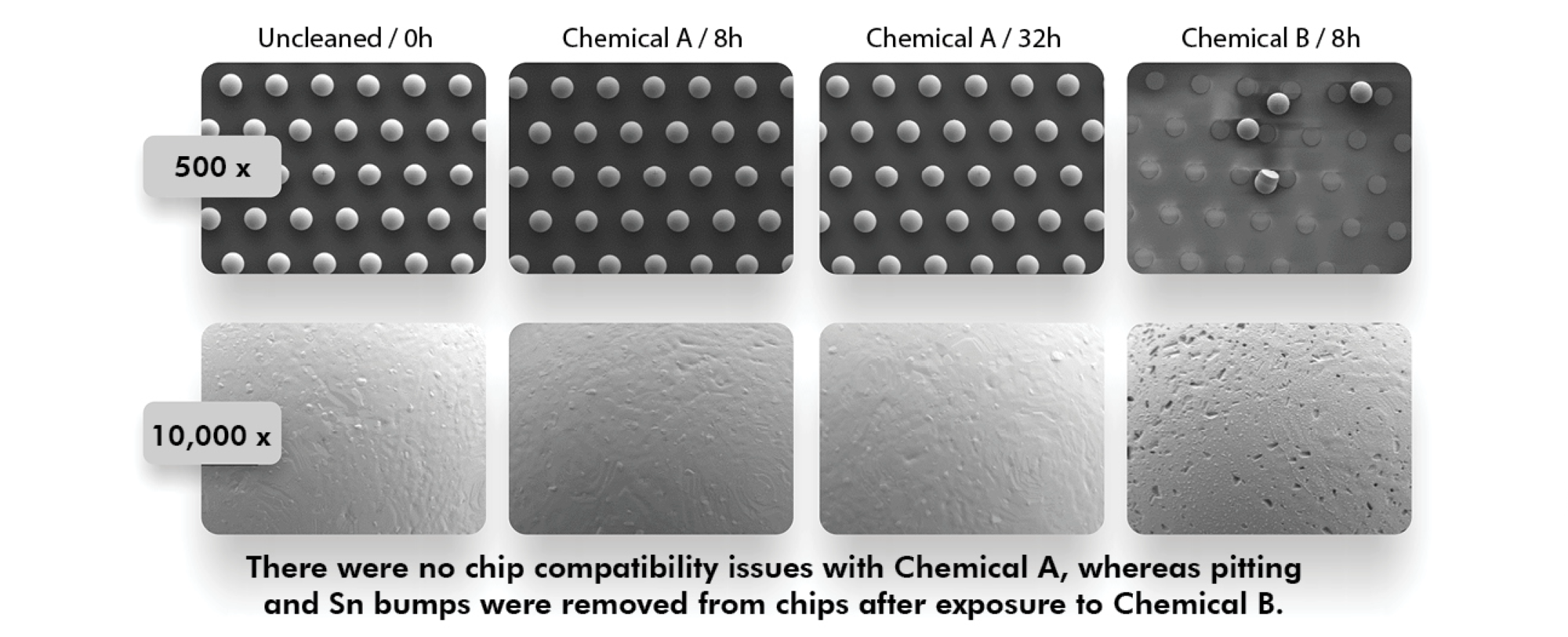
When evaluating cleaning methods for HBM wafers, consider:
- Chemical compatibilityEnsure the cleaning agent does not react adversely with HBM materials or delicate structures.
- Temperature sensitivity
Choose cleaning processes that operate within safe thermal limits to avoid damaging heat-sensitive components. process - Mechanical stressMinimize physical force during cleaning to prevent cracking or misalignment of fragile microstructures.
- Residue removal effectiveness
Use methods that thoroughly eliminate all contaminants without leaving behind trace residues. - Packaging compatibilityVerify that cleaning processes are safe for all packaging materials and interconnects used in HBM assemblies.
- Environmental impactOpt for eco-friendly cleaning solutions and processes that comply with safety and disposal regulations.
Future Trends in HBM


Hybrid Bonding and Dicing Cleanliness
Hybrid bonding enables tighter integration between memory and logic components by forming direct, atomic-level interconnects—boosting bandwidth, reducing latency, and lowering power consumption. Its success, however, depends heavily on surface cleanliness. During wafer dicing, any leftover debris or contaminants can compromise bond integrity, leading to weak adhesion or failure. To ensure reliable bonding, manufacturers must use advanced post-dicing cleaning methods that remove all residues while preserving die surface quality.
Emerging technologies


Optical Interconnects Using Photonics: Opportunities and Challenges
As high-performance computing demands grow, optical interconnects using photonics offer a promising path to faster data transfer with higher bandwidth, lower latency, and minimal interference—outpacing traditional copper connections. However, widespread adoption faces hurdles, including high integration costs, complex thermal management, and increased system design complexity. Continued innovation in fabrication and packaging will be key to making photonic interconnects a viable solution for next-generation HBM and SiP applications.
Conclusion

In conclusion, High Bandwidth Memory (HBM) emerges as a high-performance and future-ready memory solution, underscored by the critical importance of chemical compatibility and residue removal for material preservation and sustained functionality. Addressing key cleaning process factors such as temperature, agitation, and solution concentration is vital to ensure efficient cleaning versatility while ensuring compatibility with cleaning methods proves essential. Overcoming challenges in hybrid bonding, which demands meticulous cleaning for reliable bonding, and in Silicon Photonics, including cost, heat dissipation, and interconnect density, will be pivotal for advancing these technologies to their full potential.