Best Cleaners for No-Clean Flux Residue | ZESTRON Guide
No-clean flux systems reduce post-reflow cleaning needs, but residues still matter: residues can cause ionic contamination, solderability problems, and field failures. Industry data show more than 20 percent of reliability incidents trace back to improper residue control or inadequate cleaning processes. Choosing the right cleaner and validating its use prevents costly rework and increases yield.
Key takeaways
-
No-clean does not mean no residues; measure ionic contamination to assess risk.
-
Cleaner selection hinges on chemistry compatibility, solvency, and process equipment.
-
ZESTRON provides chemistry, labs, and analytical testing to validate cleanliness to IPC and J-STD standards.
-
Practical control of temperature, dwell time, and drying gives predictable results and lower waste.

Understanding no-clean flux residues on PCBs
Understanding residue chemistry is critical to selecting an effective cleaner. No-clean flux formulations are rosin-free or low-residue organic blends containing activators, tackifiers, and organic acids. Post-reflow residues are often polar, partially soluble, and can be hygroscopic.
Residues vary by flux type, solder alloy, and component density. Critical failure modes include ionic conduction, corrosion under bias, and reduced insulation resistance. Quantifying residues with ion chromatography and surface insulation resistance tests provides actionable metrics for process control.
What is no-clean flux?
No-Clean flux contains ionic activators, solvents and an inert resin/rosin. After soldering, the solvents evaporate and the inert resin layer encapsulates the ionic activators under it. Since the ionic activators are not exposed to the environment, the left over residue is considered benign and hence no-cleaning is deemed necessary. As you can see, no-clean does not mean no-residue. The residue along with the harmful ionic activators are still present on the boards, but they are just encapsulated by the resin.
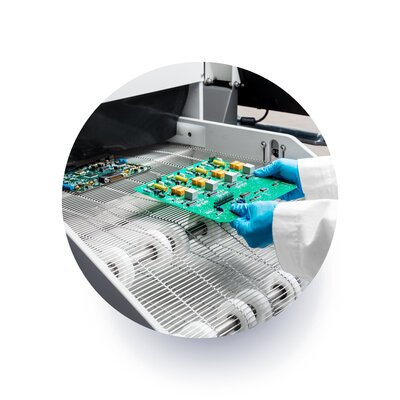 The residue continues to be benign only as long as the resin layer forms properly. Improper soldering temperatures may cause the encapsulation to be insufficient and the overall residue can be ionic in nature.
Download the "Impact of Multiple Thermal Cycles on the Cleaning Process" Case Study
Additionally, even if the resin layer is formed properly, if it gets damaged/cracked in the field, the ionic activators are now exposed and the residue isn’t benign anymore.
Most Commercial electronics that have a low cost of failure use no-clean and do not clean the residue. However, high reliability applications such as Military and Defense, Medical and Aerospace applications use no-clean flux, but specify cleaning it off. The reason no-clean flux is preferred over water-soluble flux is the flexibility it offers during the assembly process. Water-soluble fluxes are highly active and corrosive and need to be cleaned off within 1-4 hours of soldering, Whereas, the no-clean flux can be left on the boards for days before cleaning.

your product requirementsImpact of residue on PCB performance
Residues affect performance through electrical leakage, dendritic growth, and corrosion. Ionic residues increase conductivity across surface insulation, lowering dielectric strength and accelerating failure under humidity and bias. Residues trapped beneath components can also impede thermal conduction and reduce long-term solder joint reliability.
Quantitative thresholds vary by standard and application; for many high-reliability designs, total ionic contamination targets are below 1 microgram NaCl equivalent per square centimeter. Use data-driven thresholds tied to your product requirements.
What are the Reliability Risks of Residue?
The main failure mechanisms associated with not cleaning no-clean flux are Electochemical migration or Dendrite formation and Leakage current.
Electrochemical migration requires three main factors to happen – voltage, an ionic contamination source and humidity/moisture. Lets say a no-clean flux has not been cleaned, but it has ionic contamination exposed to the surface due to the resin layer being compromised. In the presence of humidity/moisture, the ionic activators can get dissolved in the moisture and can result in mobile metal ions. Now when a voltage is applied, these ions migrate towards the oppositely charged areas and can deposit there. As this process continues to happen, a metal dendrite starts to grow and can result in shorts.
Another failure mechanism that can happen is leakage current. This can happen in localized areas in the absence of voltage. Any ionic residue that is exposed can result in current flowing in areas it shouldn’t be. In addition, this can cause localized corrosion as well. 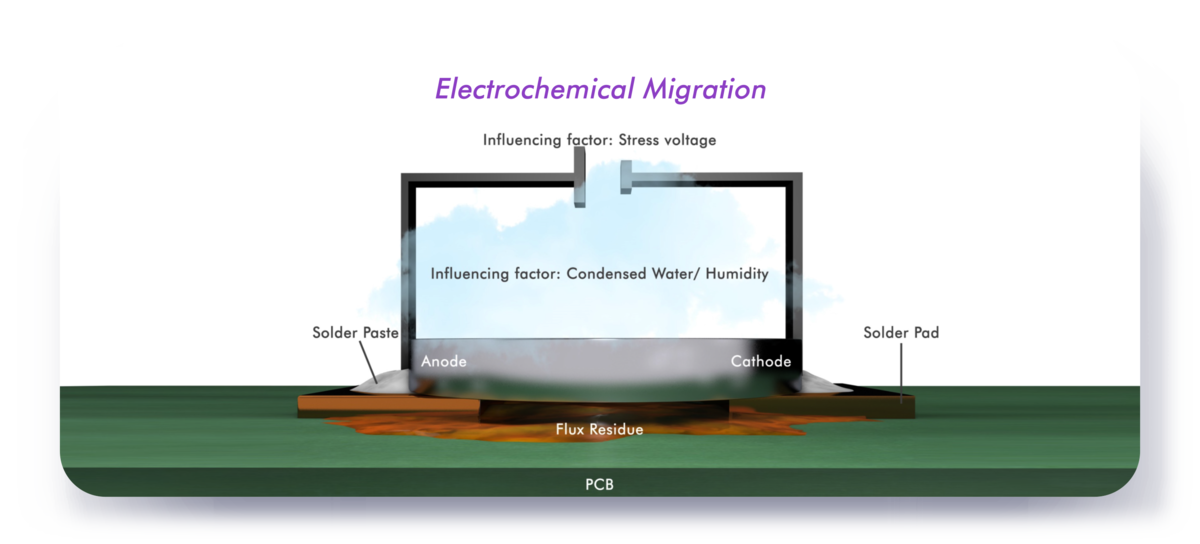
Lastly, boards that need to be conformal coated are typically recommended to be cleaned fully. Uncleaned no-clean fluxes can result in delamination or dewetting of the coating. Even though there are fluxes available that are marketed as compatible with conformal coating, the coating itself isn’t fully water-proof. Moisture can still wick through the coating and reach the no-clean residue. If the no-clean residue is compromised, you can actually see dendrite formation under the conformal coating.
When Must You Remove No-Clean?
ZESTRON has cleaners for the medical, automotive, aerospace, and high-voltage industry, where reliability is critical becasue the cost of failure could be catastrophic.
In the case of medical industry, medical devices such a pacemakers must never fail. So cleaning these to ensure no flux remains behind becomes crucial.
Automotive industry has become more and more automated. When electronic systems control more and more of the vehicle operation and in some case autonomously, the need for reliability also increases.
In the aerospace industry, especially in military and defense, reliability is paramount. In the case of space bound objects such as satellite, space vehicles etc., the cost of replacing something that fails in space is insurmountable. So reliability is crucial here as well.
The high voltage power electronics are very sensitive to any small amounts of contamination. Failures can distort signals, cause shorts, results in electrical arcing and shorts which could lead to fires. So these systems typically have very low tolerance to presence of residues.
Choosing the right cleaner: criteria and metrics
Selecting a cleaner requires matching chemistry to flux residues, equipment, and sustainability goals. Key metrics include solvency power, surface tension reduction, flash point, biodegradability, and total organic carbon removal efficiency. Measure performance with standardized tests before full-scale implementation.
Set acceptance criteria based on ionic contamination (µg NaCl/cm2), surface insulation resistance (SIR), and visual residue checks under magnification. Include process limits for rinse water conductivity and parts cleanliness to maintain reproducible results.
Types of cleaners for no-clean flux. 3 primary chemistries address no-clean flux residues:
Water-based Cleaners
Aqueous formulations with surfactants and alkalinity to hydrolyze and dissolve residues. Best for most no-clean flux removal when followed by rinsing.
- Low VOC
- Cost Effective
- Good for polar residues
Semi-aqueous Cleaners
Use a non-volatile solvent carrier with water-miscible polar solvents to solvate residues, often in spray or ultrasonic systems.
- Faster Solvency
- Reduced Water Use
- For high-reliability
Solvent cleaners
Hydrocarbon or fluorinated solvents for hydrophobic residues and applications where water is contraindicated. Best for fast drying.
- Effective on residues
- Fast Drying
- Cleans under low-standoff
How to Clean Under Bottom Termination Components (BTCs)
 BGAs
BGAs
BGAs typically have a higher standoff depending on the ball diameter. The complexity for cleaning can arise when you have low pitch (distance between BGA balls) and smaller ball diameter. When combined with a large form factor and thousands of IO count, the cleaning can become harder.
Typical cleaning processes in inline and batch cleaners can clean under BGAs effectively. Increasing exposure time is the main criteria for cleaning under components and so that will have to be optimized for each process.
Manual cleaning is not recommend for cleaning under BGAs since we cannot be sure that residues are fully removed or that the cleaning agent used has been fully rinsed/flushed out from under the BGA.
 QFN & LGA
QFNs and LGAs are some of the hardest components to clean. Mainly because they have low standoff (1-2mil) and large form factors. With QFNs, the presence of the ground pad means that there is no clear channel for the cleaning liquid to flow under. Hence cleaning and rinsing become harder. With LGAs, they tend to have much lower standoff than BGAs and hence if they have large form factor with a dense land pattern, the cleaning becomes very hard.
As with any low standoff component, the exposure time to the cleaning agent is the primary factor for these components. The machine in which the cleaning is done plays an important role as well since the chemistry has to be delivered with the right amount of flow and pressure to get under the components. Inline cleaners can be configured with various types of spray bars which help in getting under components.
What is Capillary action?
Capillary action is the mechanism by which a liquid can seep under a narrow gap due to its inherent surface tension.
How does our Cleaning chemistry penetrate?
The surface tension of our cleaning agents is typically in the 27-32 dynes/cm. When compared to DI water which as a surface tension of 72dynes/cm, our cleaning agents can penetrate much more effectively under low standoffs.
Factors to consider when selecting a cleaner
Consider these practical factors when choosing a cleaner:
- Flux chemistry and solubility profile
- Equipment type: spray, immersion, ultrasonic, or vapor
- Cycle time and throughput requirements
- Environmental, health, and safety constraints, including VOC limits
- Waste treatment and disposability costs
- Cost per board including chemistry, water, and energy
Run screening tests on representative assemblies, then scale to pilot production. Include surface analysis and functional stress tests to ensure long-term reliability.
repeatable cleanlinessZESTRON solutions and technical approach
ZESTRON is a global leader in precision cleaning and process chemistry, operating eight technical centers worldwide and serving over 2,500 customers. ZESTRON’s approach combines matched chemistries, process equipment recommendations, and analytical validation to deliver repeatable cleanliness and higher yield.
Our services include cleaning trials, residue identification, ion chromatography, SIR testing, FTIR testing, and process optimization. ZESTRON’s published case studies show measurable reductions in ionic contamination and rework rates when cleaning protocols were implemented.

ZESTRON’s cleaner portfolio
ZESTRON offers a portfolio spanning water-based, semi-aqueous, and solvent-based cleaning agents tailored for no-clean flux residues. Our formulations balance solvency, low VOC, and ease of integration into existing lines. The portfolio includes products designed for high-mix assembly, high-reliability electronics, and power electronics with robust dielectric requirements.
ZESTRON provides technical data sheets, compatibility matrices, and environmental profiles to support selection. Our chemistry options are optimized for predictable waste generation and simplified treatment.
Technical support and testing capabilities
ZESTRON supports customers with lab testing at their global technical centers, offering:
-
residue identification with FTIR and GC-MS
-
cleanliness validation to IPC and J-STD benchmarks
-
pilot cleaning trials on customer assemblies
Their technical engineers design process windows and train operators to maintain consistent results. ZESTRON’s combination of lab data and on-site support shortens time to production and mitigates risk.
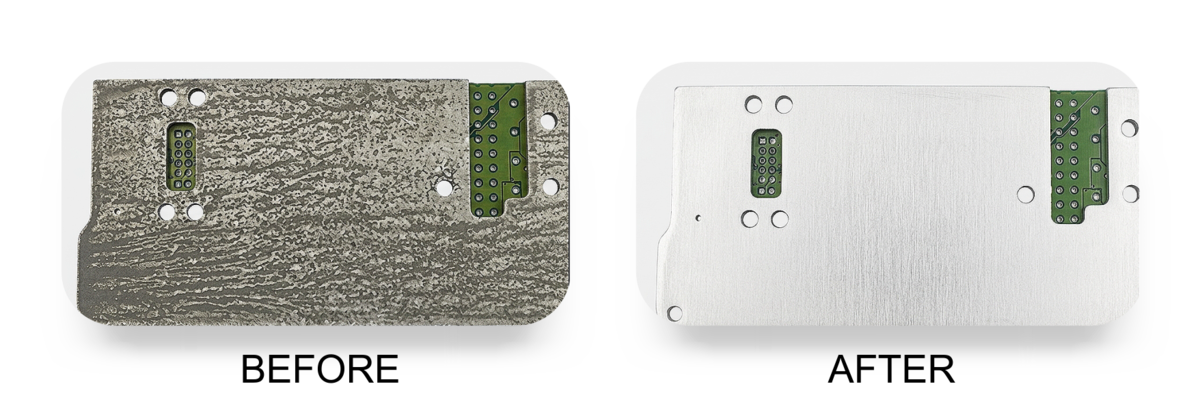
Practical cleaning parameters and workflow
Establishing a cleaning workflow requires controlling mechanical action, temperature, chemical concentration, and drying. Typical process steps include pre-clean inspection, primary cleaning, rinsing, drying, and post-clean verification. Document each step in a process control plan with acceptance criteria.
Standard operating procedures should list concentrations, water quality, filtration schedules, and waste handling. Track key performance indicators including ppm or µg NaCl/cm2, rinse water conductivity, and chemical usage per board.
Immersion vs. Spray cleaning techniques
Choose immersion or spray based on assembly density and throughput:
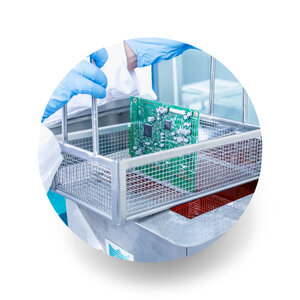
Immersion Cleaning
Immersion cleaning provides uniform contact and is forgiving for complex geometries, often paired with ultrasonic agitation.
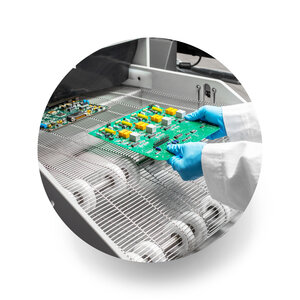
SIA Cleaning
Spray-in-air or cascade spray is common inline, offering faster cycle times and lower solvent usage.
Compare techniques by testing representative boards. Use immersion with multi-stage rinsing for high-reliability assemblies where residues hide under components. Use spray for high-volume lines with simpler geometries.
Optimizing cleaning conditions: temperature, dwell time, and drying
Optimize three variables for effective cleaning:
-
Temperature: elevated temperatures (30°-60° C) increase solvency and reduce surface tension, but watch component limits.
-
Dwell time: balance sufficient contact time to dissolve residues against throughput; typical dwell ranges are 30 seconds to 5 minutes depending on flux.
-
Drying: control drying with heated air, vacuum, or nitrogen to prevent re-deposition and watermarks.
Run design of experiments to map process windows. Record conductivity or ionic measurements after each parameter change to establish validated limits.
Validation, QA, and regulatory considerations
Validation ensures the cleaning process meets product reliability and regulatory requirements. Combine analytical testing, visual inspection, and functional testing to create a robust qualification package. Maintain traceable records for each production lot to support audits and root cause analysis.
Include preventive maintenance schedules and operator training in the QA plan. Monitor trending data to detect drift in cleanliness or equipment performance early.
Importance of cleaning validation and QA
Cleaning validation confirms the process removes residues to defined limits under normal production conditions. A validation protocol usually includes worst-case assemblies, accelerated stress testing, and long-term reliability checks. Define acceptance criteria up front and use IPC and J-STD guidance where applicable.
Regular revalidation after material, process, or equipment changes prevents latent failures. Use statistical process control to maintain capability and reportable metrics.
 Regulatory standards: IPC/J-STD compliance
IPC and J-STD documents set industry expectations for soldering and cleanliness. IPC-A-610, IPC-J-STD-001, and related standards address acceptability, while IPC TM-650 methods and J-STD-004 provide residue characterization and flux classification guidance. Use these standards as benchmarks for inspections, ionic limits, and test methods.
ZESTRON’s labs perform testing aligned to IPC and J-STD methodologies, enabling customers to demonstrate compliance and document process capability.
Conclusion and next steps
Effective removal of no-clean flux residues depends on matching chemistry, equipment, and validated process windows. Use measurable metrics - ionic contamination, SIR, and visual standards - to define success. Implement pilot testing on representative assemblies and involve suppliers early.
For teams seeking a structured program, ZESTRON offers cleaning agents, laboratory testing, pilot trials, and on-site process qualification to reduce risk and improve yield. Engage technical centers to run residue identification and build a validated cleaning protocol tailored to your products.
FAQ
The best cleaner depends on your flux chemistry, board complexity, and regulatory needs. Start with ZESTRON-supported screening that compares water-based, semi-aqueous, and solvent solutions using ion chromatography and SIR testing to pick the optimal chemistry.
Use ion chromatography to report µg NaCl equivalent per cm2, surface insulation resistance tests, and IPC visual inspection criteria. Set targets based on product reliability requirements and show repeatable results across multiple lots.
Yes. Water-based and low-VOC semi-aqueous chemistries minimize hazardous waste. ZESTRON provides environmental profiles and waste minimization strategies, including solvent recovery and centralized waste treatment solutions.
Revalidate after material, process, or equipment changes, and at scheduled intervals based on risk assessment. Many manufacturers perform partial revalidation annually and full revalidation on major changes.
ZESTRON operates eight technical centers worldwide, offering pilot trials, analytical testing, and on-site support. Visit Here to request evaluation and technical services.